Two days after PHP2Shell went public, I got a short email: “You can go ahead and update my foundation’s website as per your quote.”
I logged in and found a website like the ones I see almost every week. Not hacked. Not broken. Just forgotten.
The PHP version on the server hadn’t received security updates for a long time. The donation page with the bank details ran without encryption. On two pages, instead of a form, there was only the message “Error: contact form not found.” One of them wasn’t linked from anywhere anymore. Nobody had noticed.
The website was hosted with a large Swiss hosting company. Still, nobody had taken care of the PHP version.
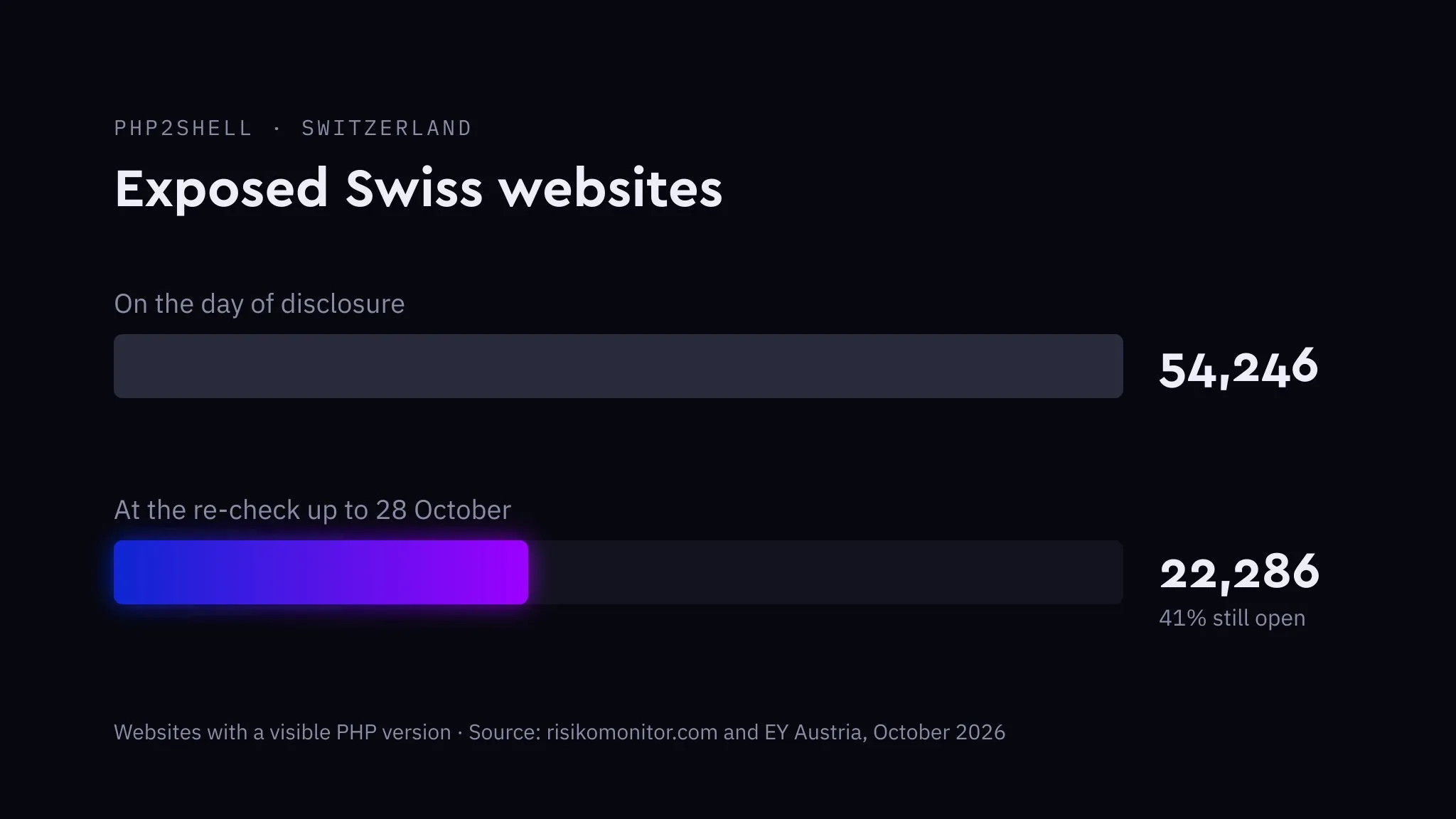
That is exactly what the PHP2Shell numbers show too. On the day of disclosure, 54,246 websites in Switzerland were exposed. A week later, 22,286 still were. The fix was available within a day. For most of the websites that stayed open, the problem started years earlier.
In this post I’ll show you what the numbers reveal, who is actually responsible for updating your website, and how to check in ten minutes whether your website is affected. And why 31 December is the next date you should know.
The essentials in five points
- PHP2Shell is two critical flaws in PHP, the language underneath WordPress, TYPO3 and Joomla. Fixed on 21 October 2026, and now actively exploited.
- In Switzerland, 54,246 websites were exposed on day one, and 22,286 a week later.
- Most affected websites ran on PHP versions that haven’t received security updates for years.
- You can find out in ten minutes whether your website is affected: look up the version in your hosting account or ask your agency.
- Support for PHP 8.2 ends on 31 December 2026. If you’re on that version, plan to switch before the end of the year.
What happened on 21 October
PHP is the programming language that a large share of all websites run on, including almost every WordPress site. On 21 October 2026, the PHP team fixed two critical flaws: CVE-2026-109618 and CVE-2026-109619, together called “PHP2Shell”, with a severity of 9.2 out of 10. They let attackers run their own code on the server without logging in.
What makes them different: the flaws are not in a plugin and not in your website’s code, but in PHP itself. A website can be well built and still be exposed.
A lot has happened since. From 24 October, the flaws were demonstrably exploited, first on decoy systems run by security researchers. The US agency CISA added them to its list of actively exploited vulnerabilities. On 19 November came the next round: 17 more flaws in PHP, seven of them critical. The current versions are 8.5.13, 8.4.28, 8.3.37 and 8.2.36.
Switzerland’s Federal Office for Cybersecurity (BACS) advises updating affected systems immediately. For versions that no longer get updates, there is only one way out: moving to a supported version.
The numbers: what PHP2Shell revealed about Swiss websites
Shortly after disclosure, risikomonitor.com and EY Austria examined the websites of all EU countries, Switzerland and Liechtenstein, 34.9 million reachable sites in total. They counted websites that publicly show their PHP version.
For Switzerland, that means:
- On the day of disclosure: 54,246 exposed websites, 3.0 percent of all websites with a visible PHP version.
- At the re-check up to 28 October: still 22,286. About 59 percent were fixed within a week, 41 percent were not.
What’s interesting is who was fast. At the first measurement, half of the affected websites were already running a fixed version, faster than with earlier major flaws. The head of the study puts it this way: “PHP2Shell showed how fast it can go when hosting companies act centrally.” The other half is the story of this post.
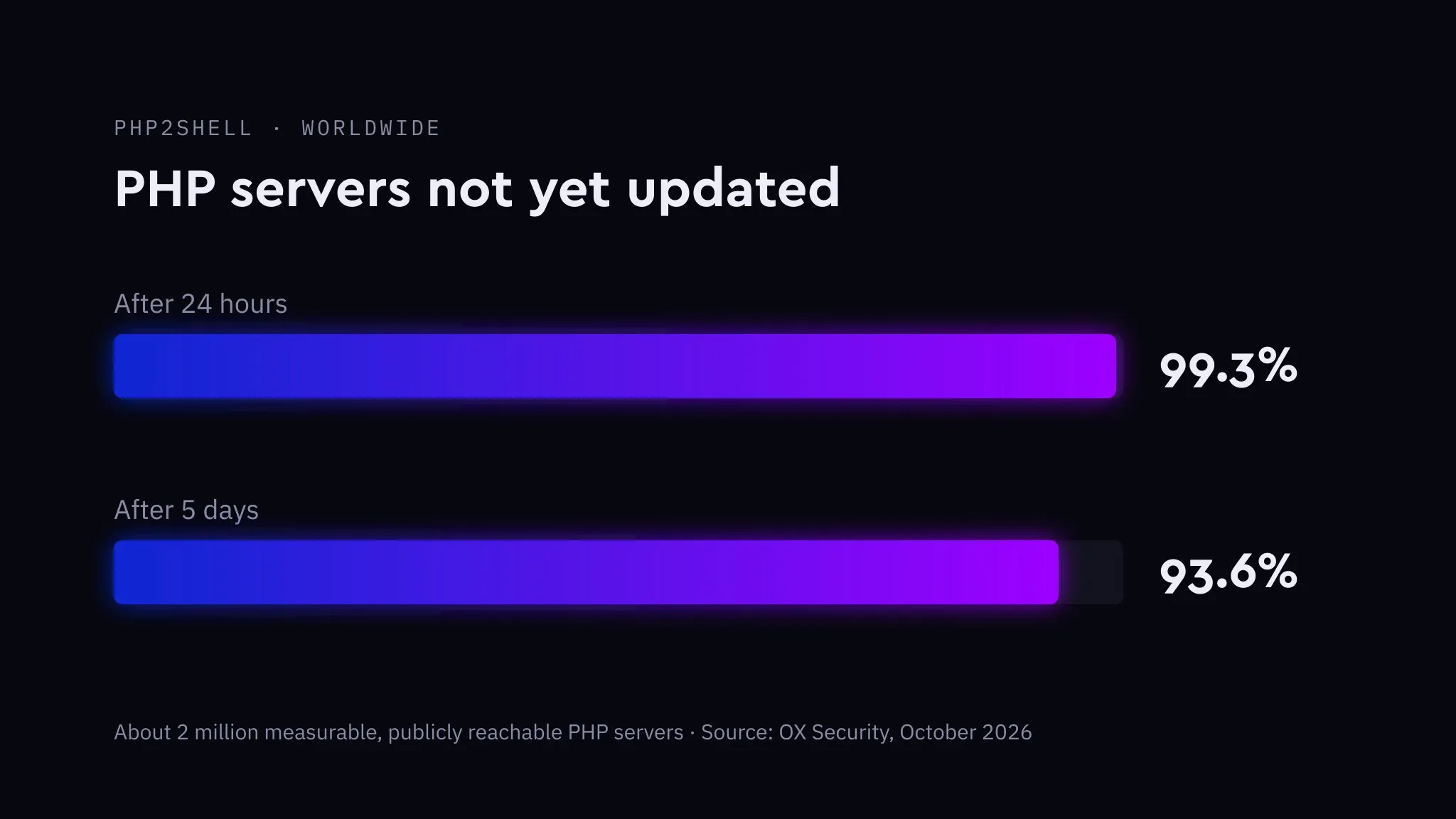
Worldwide, things looked no better. From the evening of 21 October, OX Security tracked about two million publicly reachable PHP servers. After 24 hours, 99.3 percent had not been updated. After five days, it was still 93.6 percent.
Why does an update take so long when it’s available after one day? The answer is in the next part of the study, and it has surprisingly little to do with PHP2Shell.
The real finding: 4.7 years without an update
The study also looked at which websites stayed open. The result is clearer than any PHP2Shell headline:
- 80.9 percent of the affected websites ran on PHP versions that stopped getting security updates long ago.
- The most common exposed version in Europe was PHP 7.4.33, on more than 433,000 websites. It hasn’t received any fixes since November 2022.
- On average, the affected servers had gone about 4.7 years without an update.
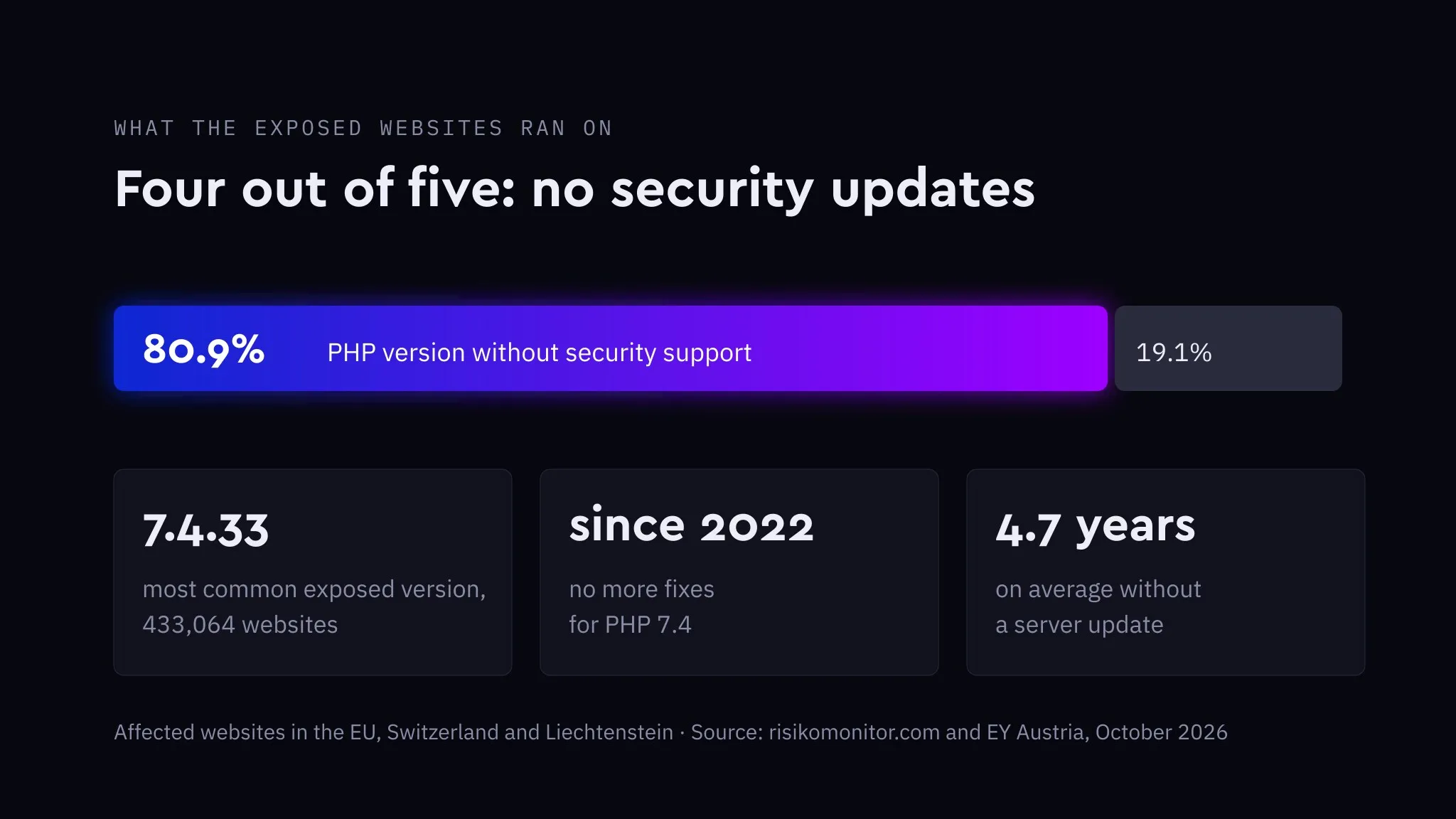
For these websites, PHP2Shell wasn’t the problem. It was just the latest of many flaws that never got fixed. The study calls it not a problem of stragglers, but a legacy problem.
I see one pattern again and again: WordPress itself is often up to date, the PHP underneath it isn’t. That matches an analysis by Censys, which found that more than one in five WordPress sites still runs on PHP 7.4, while WordPress itself is often current. You can see the update in the WordPress dashboard. Nobody sees the PHP version in the hosting account.
The foundation’s website was exactly like that. And the sentence I hear most often in these cases is well known internationally too. One developer describes it like this: “We’ve been on PHP 7.4 for five years and nobody has ever broken in.” That’s usually even true. Until it isn’t.
The fix for PHP2Shell was available within a day. The forgetting took years.
Owner, agency, host: why nobody notices
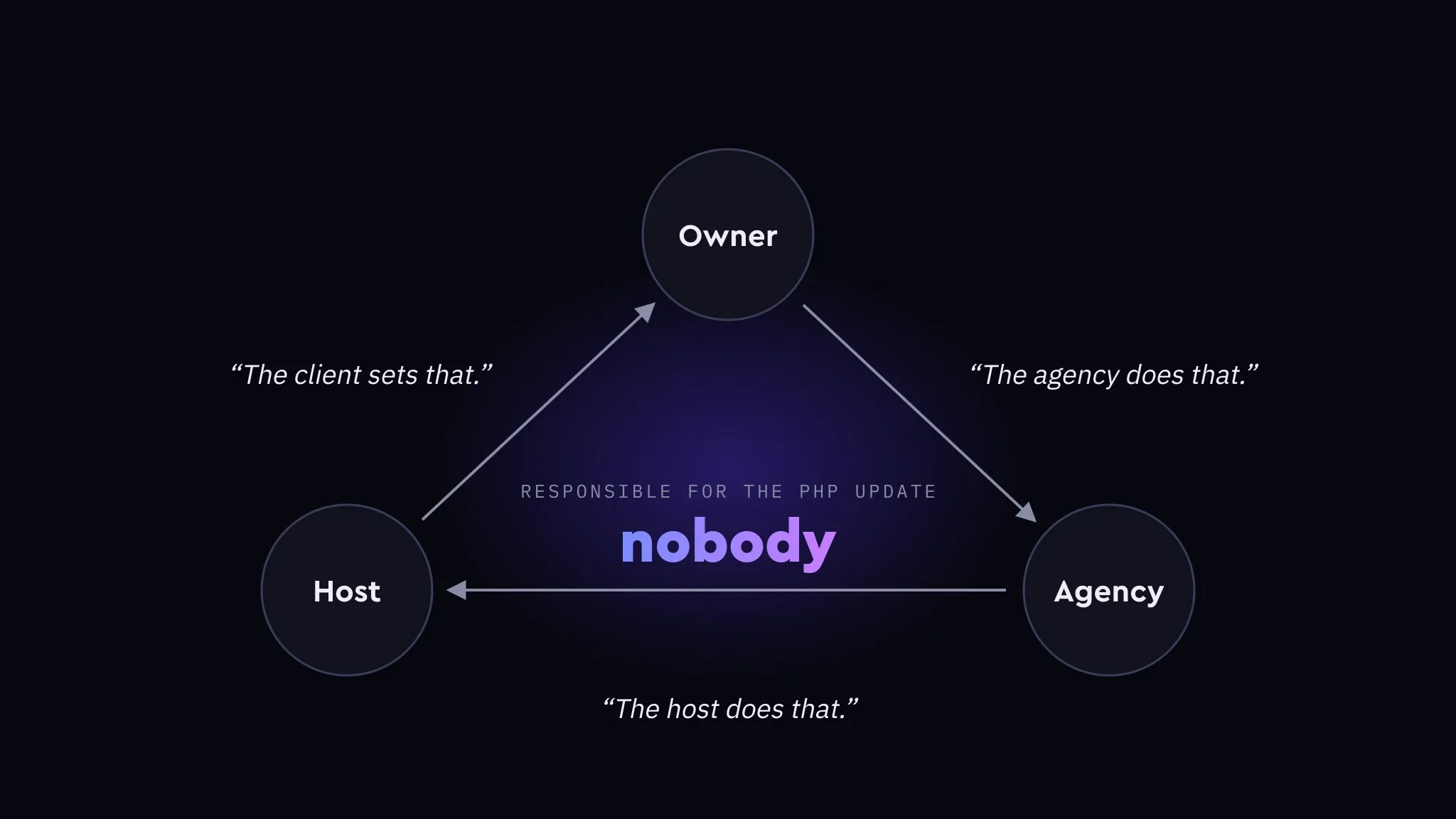
Who is actually responsible for keeping your website’s PHP version up to date? I ask this question in every website check. The honest answer is often: the owner thinks the agency does it. The agency thinks the host does it.
Both assumptions make sense, and both are only sometimes true.
What the host takes care of depends on the plan. With classic shared hosting and managed WordPress hosting, the host installs the fixes for the versions it runs. That explains why half of the websites were protected on day one. But which PHP version your website uses is, on many plans, a setting in your hosting account. The host offers the new version. Someone else has to switch to it. On your own server (VPS), PHP is entirely your job.
What the agency takes care of is in the contract, or it isn’t. Many websites were built once, handed over, and since then only updated with new content. The agency that built the site back then isn’t automatically the one responsible for updates today.
The foundation’s website was no different. The site was running, so nobody looked. The two broken forms show that nobody had looked closely for quite a while.
That’s why the most dangerous gap on many websites isn’t in any security report. It’s not in any contract.
Is my website affected by PHP2Shell?
You can find out in about ten minutes. Three ways, from fastest to most thorough:
1. Run the free check. Our Website Security Check (currently in German, works for any website) shows within seconds which system your website runs on and whether an outdated PHP or WordPress version is visible from the outside. Many servers hide their version. In that case, use way 2.
2. Look it up in your hosting account. You’ll usually find the PHP version in your web hosting settings, often under “PHP” or “PHP version”. Compare the number with the table below.
3. Ask. If you don’t have access, send this message to your agency or your host:
Subject: PHP version of our website
Hello
Could you please briefly confirm:
- Which PHP version does our website [your domain] run on?
- Are the security updates of 21 October and 19 November 2026 installed?
- Who is responsible for keeping PHP, WordPress and the plugins up to date?
- When was the website last backed up, and where is that backup stored?
Kind regards
A note on version numbers: some server operating systems ship the fix under the old version number. So an old number doesn’t necessarily mean “unprotected”. But then someone should be able to show that the fix is installed. If nobody answers your message, that’s an answer too.
Which PHP version is still safe?
| PHP version | Updates until | What to do |
|---|---|---|
| 8.6 | 31.12.2030 | New since 19 November, includes all fixes |
| 8.5 | 31.12.2029 | At least 8.5.13 |
| 8.4 | 31.12.2028 | At least 8.4.28 |
| 8.3 | 31.12.2027 | At least 8.3.37 |
| 8.2 | 31.12.2026 | At least 8.2.36, plan the switch before year end |
| 8.1 | ended (31.12.2025) | Move to a supported version |
| 8.0 and older, incl. 7.4 | ended (2022/2023) | Move to a supported version |
For PHP 7.4, 8.0 and 8.1, the PHP team made an exception and released a small emergency fix for PHP2Shell. It closes this one flaw, not the many others that have come up since. If you stay on these versions, you stay exposed.
For most WordPress sites, PHP 8.3 or 8.4 is a sensible target today. The common plugins and themes are compatible with both.
What to do before 31 December
- Make a backup before you change anything. Files and database, ideally in a second place outside the server. A PHP switch can trip up older plugins or themes.
- Move to a supported PHP version. If you’re on 8.2: plan it now, not on 30 December.
- Update WordPress, theme and plugins. If possible, test on a copy of the website first.
- Delete what nobody needs. Old plugins, a shop that was never used, test pages. Every extension is one more door. On the foundation’s website, it was a disused shop, old pages and two forms that no longer worked.
- Check encryption and forms. Does the whole website run on HTTPS, including pages with bank or personal details? Does a test enquiry arrive where it should?
- Ask about traces. An update closes the flaw, but it doesn’t remove anything that was planted before. Experts recommend having the server logs checked back to 17 October. That’s a job for your host or your agency.
- Decide who is responsible. In writing: who takes care of updates, how often, and how you hear about it.
For practices: it’s about the form
A practice’s contact form doesn’t only bring in appointment requests. Often it contains symptoms, medication or previous findings. That information is covered by professional secrecy, even when it arrives through the website.
A form is only as well protected as the server it runs on and the inbox where the requests land. Anyone who gets access to the server may also get access to what the form sends or stores. That’s why, at a dental practice we look after, appointment requests now arrive encrypted.
That’s no reason to panic. It’s a reason to ask two questions this week: Which PHP version does our website run on? And where do the requests from our form go?
Was PHP2Shell overblown?
You can see it that way. In a forum for PHP developers, someone asked a few days after disclosure whether PHP2Shell had been a “nothing burger”, a lot of noise about nothing. The feared wave of mass break-ins did in fact not happen. At the end of October, Swiss trade media reported attack attempts, not damage.
I still see it differently, for two reasons.
First: part of the reason little happened is that a lot of people updated a lot of systems in a very short time. Hosts, agencies, IT teams. In the same forum, one developer wrote, roughly: nothing happened because a lot of people worked day and night on it.
Second: the flaws have since been demonstrably exploited. And for the 22,286 Swiss websites that were still open a week later, PHP2Shell was only the latest of many flaws anyway.
So the real question isn’t whether PHP2Shell was dangerous. It’s this: when the next flaw comes tomorrow, who at your business will notice, and who will act?
What do you think? Was the fuss justified, or did it mainly bring agencies like mine new work? Tell me on LinkedIn. I read every reply, including the uncomfortable ones.
Patch or switch?
After every major security flaw, the same question comes up: should we move away from WordPress? My honest answer: not because of PHP2Shell.
A WordPress website that someone looks after regularly is a solid solution. The problem isn’t WordPress. The problem is a WordPress website that nobody looks after.
So do the honest maths: who takes care of updating PHP, WordPress, the theme and the plugins, how often, and what does that cost per year? If the answer is clear, stay.
If it isn’t, there are platforms where this work doesn’t come up in the first place. Webflow, for example, confirmed after disclosure that its core services are not built on PHP and are not affected. There’s no PHP server of your own to update, and no plugins that go out of date. That doesn’t make a website untouchable. But it takes the most common source of problems off your plate: the forgotten update.
Do you know where your website stands?
The Website Security Check shows you within seconds which system your website runs on and whether an outdated version is visible from the outside. Free, no sign-up.
If you’d rather go through it together: book a free call. I’ll look at your website with you on screen and show you what you can do yourself right away.
Sources
- risikomonitor.com and EY Austria: PHP2Shell, survey of the EU, Switzerland and Liechtenstein, October 2026
- OX Security: PHP2Shell, 24 hours in and Day 5, October 2026
- BleepingComputer: PHP2Shell security flaws now successfully exploited in the wild, 26.10.2026
- BleepingComputer: PHP security updates fix 18 flaws, including critical RCE bugs, 19.11.2026
- Netzwoche: Kritische PHP-Sicherheitslücken machen Websites angreifbar, with the BACS recommendations (in German)
- Censys: Why Are WordPress Sites Still Running EOL PHP?
- PHP: Supported versions